
Introduction
Finding the right care is not always just a clinical decision. For many older adults and families, the next question is also practical: how can the service be accessed, and which funding pathway may apply?
Funding can feel confusing because different programmes have different rules, referral requirements, eligibility criteria and out-of-pocket costs. Some people access support through My Aged Care, some use Medicare or private health insurance, some have NDIS funding, and others choose to pay privately while a longer-term pathway is being clarified.
Clinics GRP supports older adults, families, referrers and care providers across clinic, home, community, residential aged care and digital settings. The aim is to start with the care need first, then help identify which service and funding option may be the best practical fit.
Key points
- Funding should support the right care decision, not make the care pathway harder to understand.
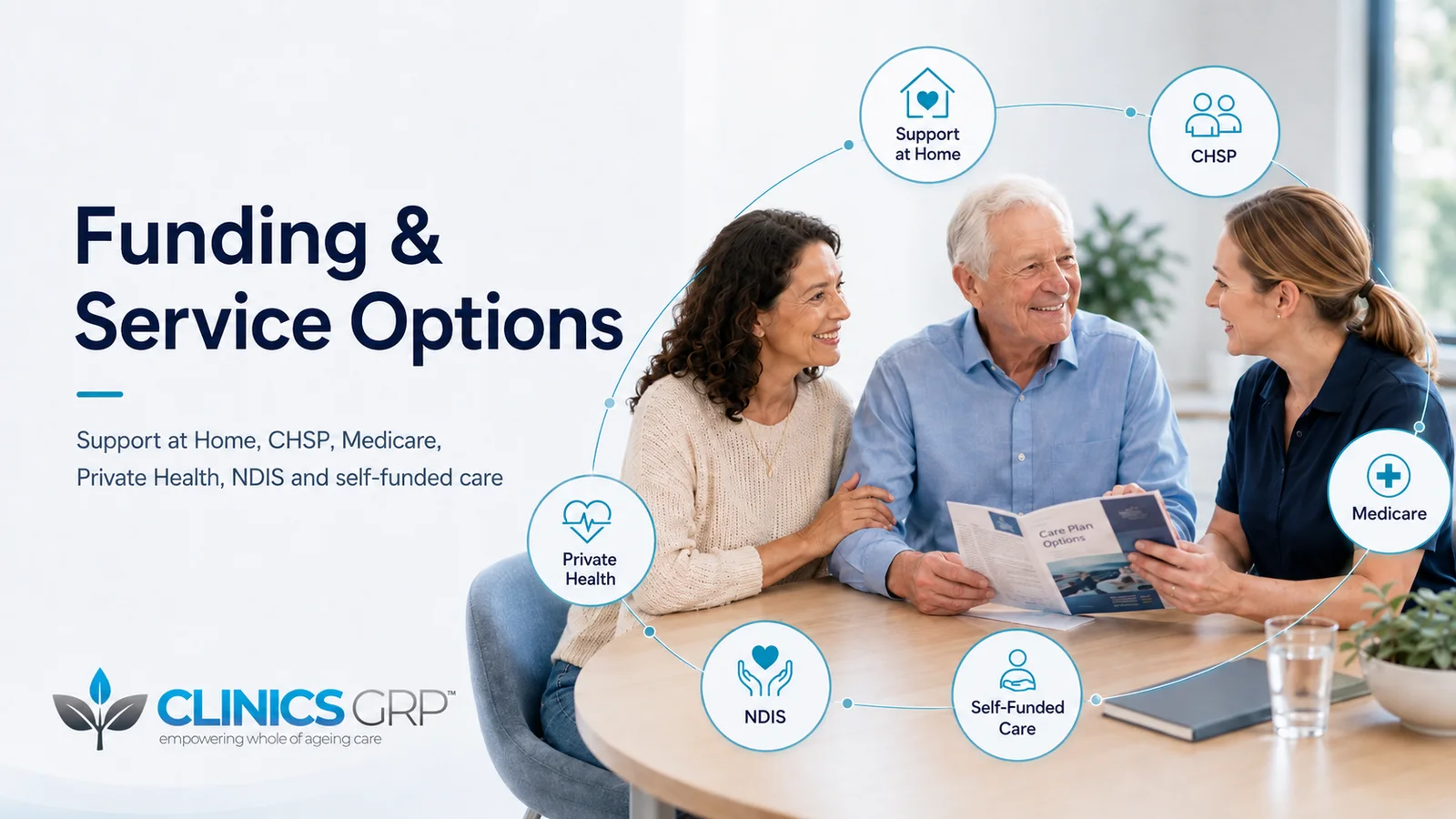
- Common access pathways may include Support at Home, CHSP, Medicare, private health insurance, NDIS and self-funded care.
- The right option depends on eligibility, the person’s assessed needs, the service required and the setting where care is delivered.
- Some people may use more than one pathway over time as their needs change.
- Clinics GRP intake can help clarify the likely service fit and what information may be needed before care starts.
Why this matters
Older adults often need support across more than one area of health and function. This may include mobility, strength, balance, recovery after hospitalisation, wound support, nursing review, dizziness, confidence with daily activities, or help staying safe and independent at home.
When funding is unclear, care can be delayed or families may feel unsure where to start. A practical service conversation can help identify:
- what the person needs help with
- whether care is best provided at home, in clinic, in the community or in a care setting
- whether a referral, care plan, package, approval or provider contact is already in place
- whether the person may need to speak with My Aged Care, their GP, insurer, NDIS planner, support coordinator or care provider
The goal is not to make families become experts in funding. The goal is to make the next step clearer.
Common funding and service pathways
Support at Home
Support at Home is a government-funded aged care programme accessed through My Aged Care pathways for eligible older adults who need more structured support to remain at home.
This pathway may be relevant for older adults who need clinically guided support such as physiotherapy, rehabilitation, balance care, nursing, therapeutic exercise, remedial massage or other healthy-ageing services, where those services fit the person’s approved support plan and funding context.
Support at Home may suit people who:
- need ongoing or higher-level support at home
- have more complex care needs
- are returning home after hospital or a change in function
- need coordinated services across more than one area
- already have a provider, care partner, coordinator or support plan in place
The Australian Government has confirmed that Support at Home replaced the Home Care Packages Program and Short-Term Restorative Care Programme on 1 November 2025. The Commonwealth Home Support Program is expected to transition to Support at Home no earlier than 1 July 2027. Funding, approvals, contributions and service availability should always be checked through current My Aged Care and provider information.
Commonwealth Home Support Program
The Commonwealth Home Support Program, often called CHSP, is designed for people who need entry-level support to keep living independently and safely at home.
CHSP may suit people who:
- need a lower level of support
- require one or two targeted services
- would benefit from early review or practical help
- need support before care needs become more complex
Depending on eligibility and local arrangements, CHSP may be relevant for services such as physiotherapy, balance support, nursing or other approved services. Availability depends on the person’s assessment, approval status, service category and provider arrangements.
Medicare
Some people may be able to access allied health support through Medicare-funded referral pathways, such as a GP-led chronic disease management arrangement or other eligible referral routes.
Medicare may suit people who:
- have a GP-led care plan
- need a defined number of allied health sessions
- are managing a chronic or complex health condition
- require physiotherapy or related support as part of broader medical care
Medicare rules, referral requirements and rebate amounts can change. A GP is the best starting point for confirming whether a person is eligible and which referral pathway applies.
Private health insurance
Private health insurance may help with the cost of some services, depending on the person’s extras cover and policy rules.
This may suit people who:
- have extras cover for physiotherapy, remedial massage or related services
- prefer to access care without waiting for a government-funded pathway
- are using clinic-based or eligible allied health services
- want to check whether a rebate may apply
Rebates vary between health funds and policies. It is important to check the service category, provider eligibility, annual limits, waiting periods and any out-of-pocket costs directly with the insurer.
NDIS
The National Disability Insurance Scheme may fund therapy or support for eligible participants when the service is consistent with the person’s approved plan, disability-related needs and goals.
NDIS may suit people who:
- are already NDIS participants
- have therapy supports included in their plan
- need physiotherapy, balance work, rehabilitation or other therapy connected to plan goals
- have a plan manager, support coordinator or nominee involved
NDIS fit depends on the approved plan, funding category, goals and service purpose. It is helpful to have plan details available before booking so the service can be checked against the person’s funding context.
Self-funded care
Self-funded care means the person, family or representative pays directly for the service.
This may suit people who:
- want to start quickly
- are waiting for an assessment, approval, referral or funding allocation
- need a service that does not clearly fit another funding pathway
- want to bridge a gap while longer-term arrangements are clarified
- prefer direct access to the broader service mix
Self-funded care can sometimes be the simplest starting point when the care need is clear but the funding pathway is still being worked out.
Service options through Clinics GRP
Clinics GRP provides services across several care settings, including clinic, home, community, residential aged care and digital support. The right setting depends on the person’s goals, mobility, safety, transport, function, recovery stage and care needs.
Service options may include:
- physiotherapy
- home physiotherapy
- rehabilitation
- balance and falls support
- vestibular care
- nursing services
- remedial massage therapy
- therapeutic exercise
- healthy ageing support
- post-hospital rehabilitation
- digital resources and pathway guidance
Some people need one service only. Others may move between services over time, such as physiotherapy after hospital discharge, nursing review at home, balance rehabilitation, therapeutic exercise, or remedial massage as part of comfort and movement support.
What helps the funding conversation go faster
Before contacting intake, it can help to gather any information already available. You do not need everything, but useful details may include:
- current My Aged Care, Support at Home or CHSP information
- referral codes, approval letters, support plans or package details
- GP referral, discharge summary or care plan
- private health insurance details if a rebate may apply
- NDIS plan information, goals and plan management details
- the main reason care is needed
- whether home, clinic, community or residential care support is preferred
- contact details for the person, family member, care coordinator, provider or referrer
If the funding pathway is not clear, it is still appropriate to start with the care need and ask what information is required next.
How Clinics GRP can support you
Clinics GRP helps older adults, families, referrers and care providers work out the most practical next step for care. Intake can consider the person’s care need, preferred setting, funding context and service fit.
This may include helping to clarify:
- which funding pathway appears most relevant
- which Clinics GRP service may be the best starting point
- whether care is more suitable at home, in clinic, in the community or in a care setting
- what documents or approvals may be needed before care starts
- whether another provider, GP, insurer, support coordinator or care manager should be involved
The focus is practical service navigation, not making families work through the system alone.
When to seek urgent help
Funding and service planning should not delay urgent care.
Seek urgent medical help if there is:
- sudden weakness, facial drooping, difficulty speaking or confusion
- chest pain, shortness of breath or fainting
- a fall with head injury, severe pain or inability to get up safely
- sudden severe dizziness, loss of balance or new neurological symptoms
- signs of serious infection, rapidly worsening symptoms or significant concern
In an emergency, call 000 in Australia.
Next steps
- Start with the care need: what has changed, what is difficult, and where support is needed.
- Gather any current funding, referral, package, provider, insurer or NDIS information.
- Contact Clinics GRP intake to discuss which service and access pathway may be appropriate.