
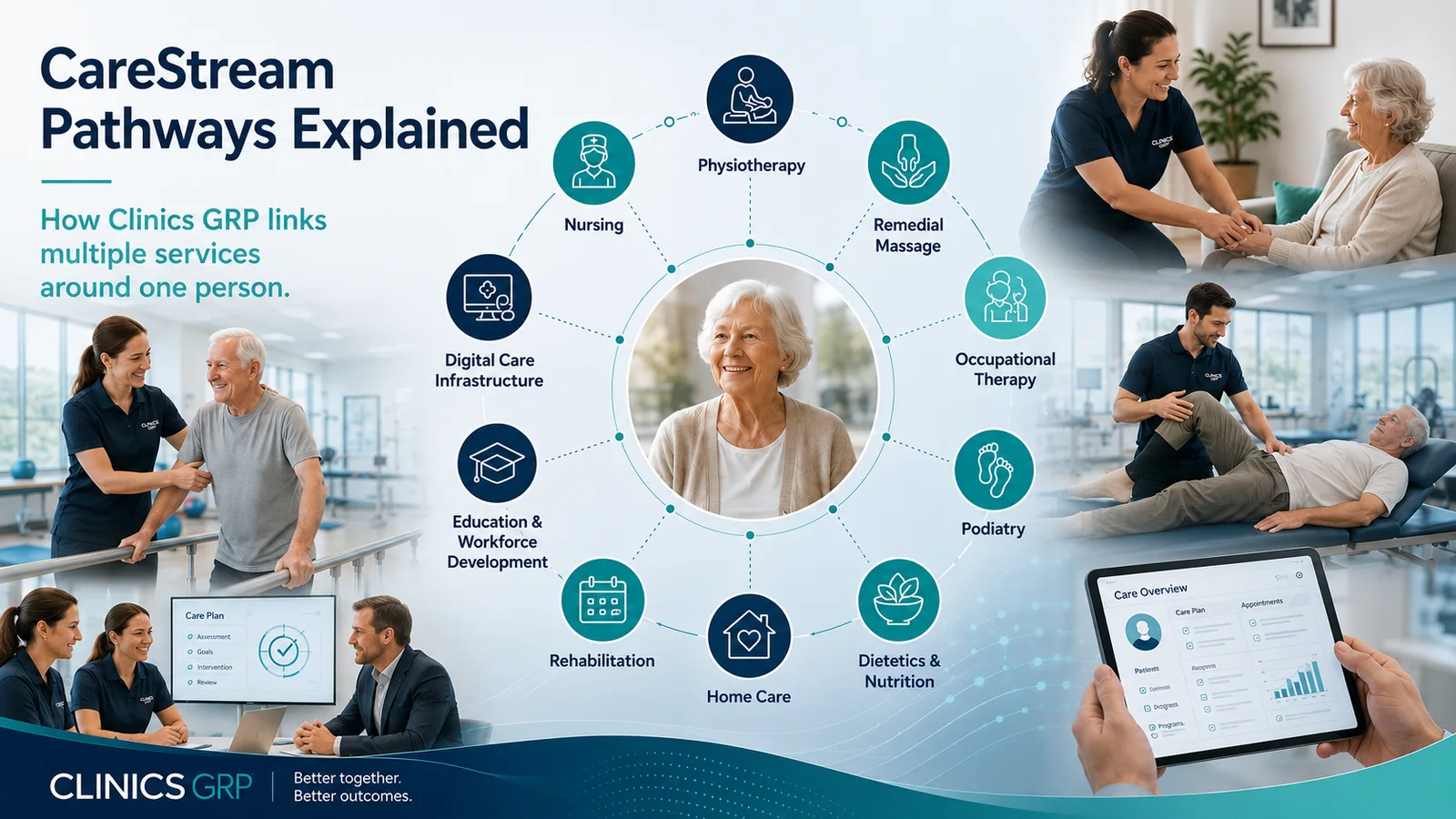
CareStream Pathways Explained: How Clinics GRP Links Multiple Services Around One Person
Older adults rarely need just one isolated service.
A person may start with physiotherapy after a hospital stay, then need home visits, nursing input, a balance programme, communication with their GP, help from a family representative, and later a review of their progress. Without a clear structure, these services can become fragmented.
Clinics GRP uses the concept of a CareStream to keep care connected around the person.
What is a CareStream?
A CareStream is a defined block of care with a clear purpose, start point, review process and end point. It links the person, the care goal, the service setting, the treating team, the funding pathway, appointments, notes, reports, communication and review requirements into one coordinated pathway.
Instead of viewing each appointment as a separate event, a CareStream asks a more useful question:
What block of care is this appointment part of, and what is it trying to achieve?
This helps the care team understand why the service is being delivered, who is responsible, what has already happened, and what should happen next.
Why CareStreams matter
Many older adults move between different types of care. One person may receive services:
- in a clinic
- at home
- in a community exercise programme
- after a hospital admission
- in residential aged care
- through telehealth or digital support
- under a private, Medicare, My Aged Care, CHSP, NDIS or other funding pathway
Each of these settings may involve different clinicians, administrative processes, documentation requirements and funding rules.
A CareStream gives the person one connected pathway rather than a series of disconnected services.
How a CareStream links services together
A CareStream can connect multiple parts of care, including:
- the client’s central record
- the reason for care
- the treating clinician or team
- appointments
- clinical notes
- outcome measures
- progress reviews
- provider reports
- communication with family, carers, GPs or other providers
- funding or authorisation requirements
- tasks and follow-up actions
- discharge or handover planning
This means the care team can see the whole picture, not just the next appointment.
Example: one person, several connected services
An older adult may be referred after a hospital admission for a fall.
Their first CareStream may focus on post-hospital rehabilitation. This could include an initial physiotherapy assessment, home visits, strength and balance exercises, falls risk screening and communication with their provider or GP.
As they improve, the pathway may change. They may move from home visits into an in-community balance programme. Later, they may continue with periodic reviews, a group exercise programme, or a new CareStream if their goals or health status change.
The important point is that each stage is connected. The new service does not start from a blank page. It builds on the person’s previous assessments, goals, risks, communication history and outcome measures.
Different types of CareStream pathways
Clinics GRP can use CareStreams across different care settings.
InClinic CareStream
This pathway supports appointment-based care delivered in a clinic. It may include physiotherapy, remedial massage, vestibular physiotherapy, rehabilitation reviews, pain or mobility management, and follow-up appointments.
InHome CareStream
This pathway supports care delivered in the person’s home. It is commonly used when mobility, transport, frailty, safety, post-hospital recovery or functional goals make home-based care more appropriate.
InCommunity CareStream
This pathway supports group or programme-based care, such as balance classes, therapeutic exercise programmes or movement-based programmes. A person may attend a group programme on its own, or it may form part of a broader individual CareStream.
InHospital or Rehab CareStream
This pathway supports rehabilitation-style care after an admission, procedure, health event or functional decline. It may involve a more structured period of assessment, intervention, review and transition planning.
InCare CareStream
This pathway supports care delivered in residential aged care or similar care environments. It may include mobility, falls prevention, function, pain, pressure injury risk, weight-related concerns, nursing input, or ongoing review.
Digital or Virtual CareStream
This pathway may support telehealth, digital monitoring, medication-related screening, symptom tracking, education or other remote care tools where clinically appropriate.
CareStreams help the team adapt care over time
A CareStream is not meant to be rigid. If a person’s needs change, the pathway can be reviewed and adjusted.
For example, the team may:
- extend the duration of care
- increase or reduce visit frequency
- add another discipline
- change the care setting
- repeat outcome measures
- create a new CareStream when the care goal changes
- close the current CareStream when the episode is complete
This is particularly important for older adults, because needs can change quickly after illness, hospitalisation, falls, medication changes, functional decline or improvements in mobility and confidence.
CareStreams support safer communication
When care is fragmented, important information can be missed.
A CareStream helps communication stay linked to the person’s care pathway. Messages, provider updates, appointment reminders, clinical reports, GP letters and family communication can be connected to the relevant CareStream.
This gives staff a clearer history of what has been sent, what has been approved, what is pending and what needs follow-up.
CareStreams support funding and provider requirements
Many older adults receive care through a funding or provider pathway. This may include My Aged Care, CHSP, Home Care Package-style funding, NDIS, private health insurance, Medicare or private payment.
A CareStream helps ensure that services are linked to the correct funding pathway, approval status and reporting requirements.
For provider-managed care, this may include:
- referral intake
- triage
- initial assessment
- recommendations to the provider
- provider approval
- approved session limits
- progress reports
- further approval requests
- discharge or handover documentation
This helps the care team deliver services within the approved scope and reduces the risk of missed reporting or unclear authorisation.
CareStreams support better review and continuity
A CareStream gives the team a structured way to ask:
- What was the person’s starting point?
- What were the goals?
- What services were delivered?
- What changed?
- What outcome measures were used?
- What risks need ongoing attention?
- Should care continue, change, step down or close?
This makes review more meaningful. It also helps future clinicians understand what has already happened if the person returns for care later.
What this means for clients and families
For clients and families, the benefit is simple: care should feel more coordinated.
A CareStream helps ensure that the person does not have to keep retelling their story to every clinician or service. It gives the care team a shared understanding of the person’s goals, needs, risks and care history.
It also supports clearer communication about what the current block of care is for, who is involved, and what the next step may be.
What this means for Clinics GRP
For Clinics GRP, CareStreams create a consistent way to organise care across multiple services and settings.
They help link clinical care, administration, communication, documentation, funding and governance into one pathway. This supports safer service delivery, clearer accountability, better continuity and more useful review of outcomes over time.
In summary
A CareStream is Clinics GRP’s way of organising care around the person, not around isolated appointments.
It allows multiple services to connect into one clear pathway, so care can move from clinic to home, community, hospital, residential care or digital support without losing the thread of the person’s goals, history and needs.
For older adults with changing health, mobility and support needs, this connected approach is essential.